
ClEAn POTASSIuM fORMATE, A PROMISInG fuTuRE
Potassium formate is in high demand due to the increased need for eco-friendly products. On the other hand, production of potassium formate involves processes that are energy-intensive and reliant on fossil fuels, leading to significant GHG emissions. These processes can have a high environmental impact, including pollution from energy use and waste by-products. Finaly, raw materials for potassium formate production are subject to market volatility, geopolitical issues, and resource depletion, posing risks to supply chain stability.
This is why at Electro Carbon we believe that adopting new sustainable production methods for potassium formate offers numerous benefits, from reducing GHG emissions and environmental impact to securing the supply chain and enhancing cost efficiency. These methods align with global sustainability goals and regulatory requirements, providing companies with a competitive advantage and contributing to a cleaner, more sustainable future.


THE DE-ICING SOLUTION
EcoWay50: a deicing solution that combines performance and responsibility at every stage, from production to biodegradation.
Cleaner to produce.
More efficient to use.
More environmentally responsible during biodegradation.
-
AMS1435 certified for airport use
-
Manufactured in Québec, Canada
-
Offered at a highly competitive price
CURRENT MARKET SITUATION
Deicing is essential to ensure the safety and continuity of airport operations during winter conditions.
Historically, deicing agents used on runways and airport infrastructure relied on substances such as urea, as well as formulations derived from fossil fuels. While operationally effective, these products present significant environmental impacts, both through their contribution to carbon emissions and their pollutant load once released into the environment.
After application, deicing products inevitably enter stormwater management systems and surrounding aquatic environments. Two key indicators are used to assess their environmental impact: Biochemical Oxygen Demand (BOD) and Chemical Oxygen Demand (COD). High BOD and COD values indicate increased oxygen consumption during substance degradation, which can harm aquatic ecosystems and overload water treatment systems.
In a context where airport operators and public authorities must balance winter performance, regulatory compliance, and environmental protection, reducing the environmental footprint of deicing agents has become a critical issue.
As requirements for sustainability, water management, and responsible procurement continue to intensify, demand for local, high-performance, low-environmental-impact deicing solutions continues to grow.

BEnEfITS Of ElECTRO CARBOn POTASSIuM fORMATE fOR DE-ICInG
Certified AMS-1435
Because of these characteristics, Potassium formate-based products are certified AMS-1435 and used globally by airports for de-icing runway
Reduced GHG Emissions
64% reduction in GHG emissions through our production method using captured CO₂ and clean electricity compared to conventional production methods using fossil fuels.
Locally Produced
Provide supply chain security and lower transportation cost GHG emissions. Thanks to its unique and innovative process.
Performance at Low Temperatures
Effective down to -55 degrees Celsius, allowing for reduced spreading volumes.
Biodegradable
Potassium formate is biodegradable, which means it breaks down more easily in the environment, reducing the risk of accumulation and long-term soil and water pollution like road salts.
Non-corrosive
and Chloride-free
It does not accelerate the degradation of fragile and important infrastructure (bridges, ports, sidewalks, roads, buildings).
TOWARDS
A CLEAN FUTURE
The market is ripe for innovative solutions that address operational needs, supply chain security, and environmental responsibilities.
Electro Carbon’s potassium formate represents a significant step towards sustainable de-icing practices. By embracing this technology, industries can enhance safety, reduce environmental impact, and move closer to a carbon-neutral future.

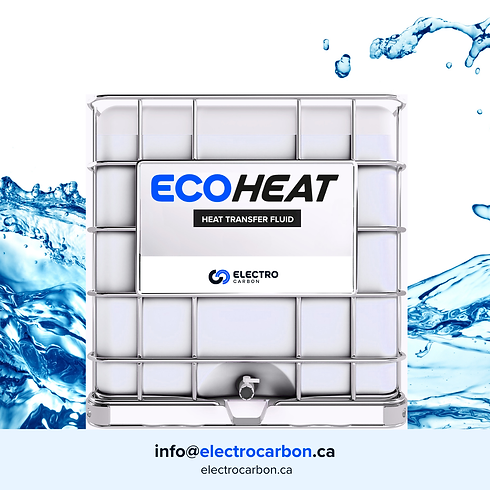

HEAT TRANSFER FLUID INDUSTRY
EcoHeat is a range of potassium formate-based heat transfer fluids designed for industrial systems and district energy networks.
Produced using CO₂ and clean electricity, this solution delivers high thermal performance, low viscosity, and a reduced environmental impact, while offering a safer and less polluting alternative to traditional fluids such as glycols.
CURRENT MARKET
The heat transfer fluids market is witnessing steady growth due to the increased demand in various industries such as HVAC, chemical processing, oil & gas, pharmaceuticals, food & beverage, and renewable energy. These fluids are essential for efficient thermal management in processes involving heating, cooling, and energy transfer.
Historically, propylene glycol and ethylene glycol have been commonly used in heat transfer systems in the HVAC (heating, ventilation and air conditioning) industry.
There are three types of fluids: mineral salt brines, alcohols and glycols, and non-aqueous fluids such as mineral and synthetic oils.
Glycols are mainly derived from fossil fuels, generating high GHG emissions, but they can also cause other problems. Ethylene glycol is very toxic. Propylene glycol is good for the environment, but can be harmful in a closed loop that is supposed to last 20 years. Propylene glycol can degrade into products such as formic acid, and corrode pipes.
The heat transfer fluid market is vital to many industries, but traditional fluids pose significant environmental challenges.
PRODUCT PROPERTIES
-
pH = 8–9
-
Clear and transparent liquid
-
Odorless
-
Uniform and homogeneous appearance, with no visible precipitate
ENVIRONMENTAL PROFILE
Formulated without chlorides, nitrites, amines, borates, lead, mercury, cadmium, hexavalent chromium, polybrominated biphenyls (PBB), or polybrominated diphenyl ethers (PBDE). Non-toxic, biodegradable, and designed with a low environmental footprint.
SUPPLY AND STORAGE
Available in tanker trucks and IBC totes. Can be stored in stainless steel tanks, alkali-resistant plastic containers, or mild steel tanks lined with synthetic resin coatings.

BEnEfITS Of ElECTRO CARBOn POTASSIuM fORMATE AS A HEAT TRAnSfER fluID

THERMAL PERFORMANCE
Available in concentrations ranging from 10% to 50%, EcoHeat is a high-performance heat transfer fluid featuring high specific heat capacity, excellent thermal conductivity, and a broad operating range down to -55°C. At low temperatures, its low viscosity improves pumpability and can reduce associated pumping energy consumption by 20% to 50% or more.
THERMAL SYSTEM PROTECTION
EcoHeat is a potassium formate-based solution that is non-corrosive and chloride-free. Its inhibitor package protects a wide range of metals and alloys, while its chemical stability, unlike glycol-based fluids, prevents the formation of organic acids that may accelerate corrosion. provides an expected service life of 15–20 years.
LOCAL PRODUCTION
Produced in Quebec.
The only heat transfer fluid produced using CO₂ and renewable electricity.
APPLICATIONS
-
Data centers
-
Refrigeration, HVAC, and freezing systems
-
District energy networks and thermal loops
-
Food and beverage industries
-
Ice skating rinks
-
Mining and construction
-
And many more
KEY TECHNICAL FEATURES
-
High thermal conductivity
-
High specific heat capacity
-
Low viscosity at low temperatures
TOWARDS A CIRCulAR ECOnOMY
By using captured CO₂, this method turns waste into a valuable resource, promoting a circular economy and reducing dependence on non-renewable resources.
The production process and final use of potassium formate-based fluids result in lower environmental pollution, protecting soil and water quality in drilling areas.

.jpg)
A sAFER ALTERNATIVE TO ALCOHOL AND gLYCOL-BASED FLUIDS FOR WINTER MUNICIPAL oPERATIONS
Paving, cutting and compaction work performed in winter conditions presents unique challenges. When water freezes and conventional solutions become incompatible with occupational health and safety requirements or high-temperature applications, operations can be slowed or even brought to a halt.
EcoCity helps keep operations moving with a safe, high-performance solution compatible with applications involving surface temperatures of up to 170°C (338°F).


Applications and storage
Compatible with municipal spraying and liquid application equipment.
Available in:
• Tanker trucks
• IBC containers
Can be stored in:
• Stainless steel tanks
• Plastics resistant to alkali products
• Synthetic resin-coated steel
Environmental profile
• Reduced impact on wastewater systems
• Low levels of BOD and COD compared to conventional solutions
• Compatible with municipal environmental objectives
Application
Designed for:
-
Concrete cutting
-
Asphalt cutting
-
Compaction rollers
-
Vibratory plate compactors
-
Winter paving
-
Municipal road work
-
Infrastructure rehabilitation
-
Construction sites where water is incompatible with operations
OHS Compliance
Meets modern occupational health and safety requirements:
✔ Methanol-free
✔ Ethanol-free
✔ Isopropanol-free
✔ Glycol-free
✔ Compatible with applications involving surface temperatures up to 170°C (338°F)
✔ No harmful vapours requiring respiratory protection

TOWARDS lOCAl AnD COnTInuOuS PRODuCTIOn
Locally produced potassium formate offers significant advantages in reducing supply chain risks. It ensures more stable, cost-effective, and environmentally friendly operations during unstable geopolitical periods.
Electro Carbon’s potassium formate, synthesized locally from CO₂ and renewable energy, provides a comprehensive solution to the environmental challenges posed by traditional drilling fluids. It combines the benefits of reduced greenhouse gas emissions, lower toxicity, improved performance, and supply security, making it a more sustainable choice.